If you’ve been asking yourself what is A2 ghee and whether it’s actually worth switching to, you’re not alone. The term has exploded across health food shelves, Instagram reels, and Ayurveda circles — and for good reason. Understanding what is A2 ghee correctly can genuinely change how you think about the fat you cook with every day.
Let’s cut through the noise and give you the real picture.
What Is A2 Ghee, Really? The Science Behind the Name
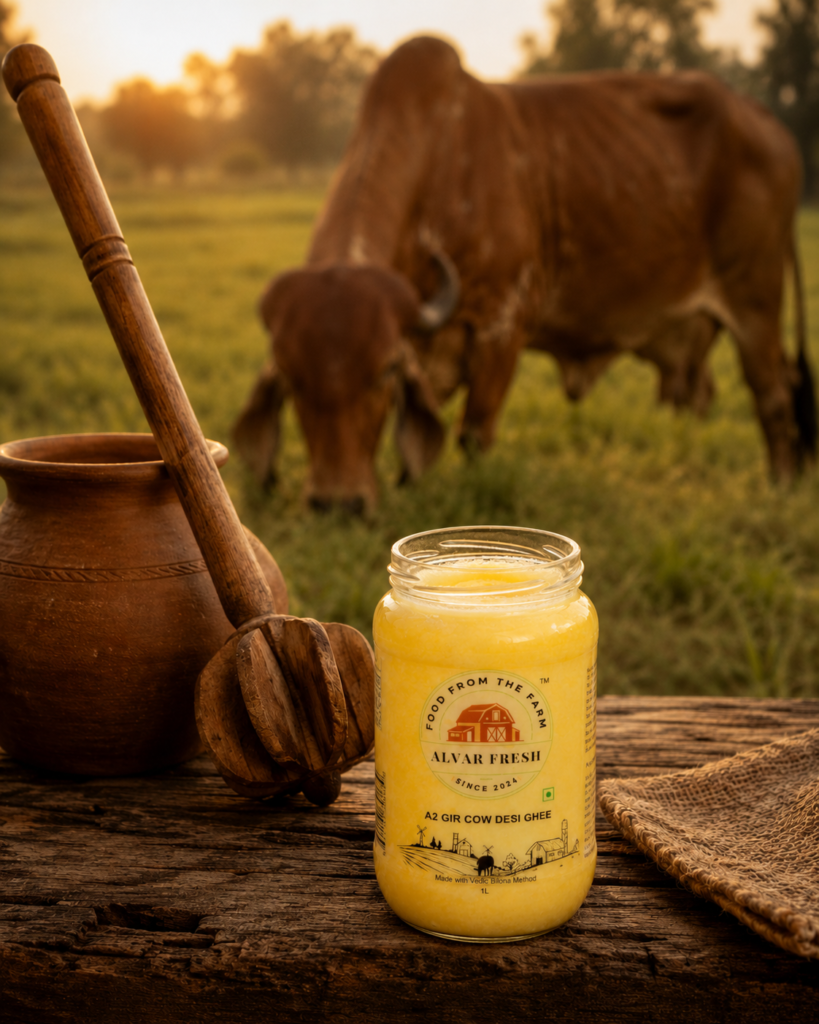
To understand what is A2 ghee, you first need to understand the milk it comes from.
All cow milk contains a protein called beta-casein. Depending on the breed of cow, this protein takes one of two forms — A1 or A2 — differentiated by a single amino acid at position 67. That one amino acid difference changes how your body digests it.
When A1 beta-casein is digested, it releases a peptide called BCM-7 (beta-casomorphin-7). BCM-7 is an opioid peptide that some researchers associate with inflammation, gut discomfort, and digestive issues in sensitive individuals.
A2 beta-casein doesn’t produce BCM-7. It digests more cleanly — closer to how human breast milk behaves in the body.
So what is A2 ghee in this context? It’s ghee made exclusively from the milk of A2-type cows, where that cleaner digestion pathway begins right at the source.
Which Cows Produce A2 Milk?
Indigenous Indian desi breeds — Gir, Sahiwal, Red Sindhi, Rathi, Tharparkar — are naturally A2. These are the ancient cattle of this land, undisturbed by industrial crossbreeding.
Most commercial dairy breeds, including the widely farmed Holstein-Friesian, produce A1 milk. Crossbreeds, which dominate India’s commercial dairy sector, are often a mix of both.
What This Means for the Ghee in Your Kitchen
This is the heart of what is A2 ghee as a category — and what is A2 ghee if not a direct reflection of its source — the breed determines the milk’s beta-casein type, which determines the ghee’s fundamental character. Two jars labeled “pure cow ghee” can be nutritionally worlds apart if one comes from an A2 desi cow and the other from a commercial crossbreed.
Is A2 Ghee Actually Better Than Regular Ghee?
Once you understand what is A2 ghee, the comparison question naturally follows — and the honest answer has two parts.
Regular ghee is still ghee. It contains butyric acid, fat-soluble vitamins A, D, E, and K2, and CLA (conjugated linoleic acid). It’s not harmful for most people.
But for people who’ve always suspected ghee doesn’t agree with them — the bloating, the heaviness, the post-meal sluggishness — A2 ghee often tells a different story. The absence of BCM-7 in the digestion pathway is the likely reason why many people find A2 ghee noticeably easier to tolerate.
Beyond digestion, understanding what is A2 ghee also means appreciating that grass-fed desi cows produce milk with a richer beta-carotene content, which translates into that signature deep golden color and a higher antioxidant profile. This is part of what makes A2 ghee nutritionally distinct, not just marketably different.
For everything the science says about ghee and your health beyond just the A1/A2 distinction, read our detailed post: Is Ghee Good for Health? Here Is What Nobody Is Telling You Honestly.
Recommended products
-
Alvar Fresh Bilona Desi Ghee – 1L
Original price was: ₹1,950.00.₹1,650.00Current price is: ₹1,650.00. -
Alvar Fresh Bilona Desi Ghee – 250 ML
Original price was: ₹699.00.₹450.00Current price is: ₹450.00. -
Alvar Fresh Bilona Desi Ghee – 2L
Original price was: ₹3,850.00.₹3,750.00Current price is: ₹3,750.00. -
Alvar Fresh Bilona Desi Ghee – 500 ML
Original price was: ₹1,100.00.₹840.00Current price is: ₹840.00.
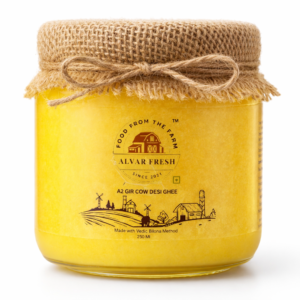
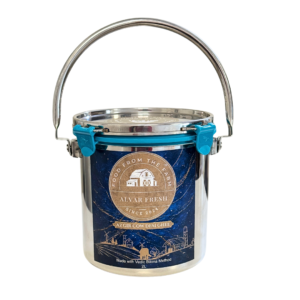
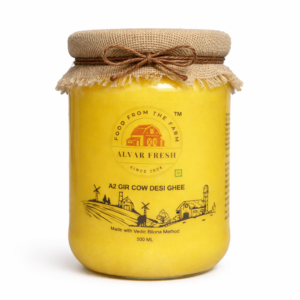
Try Our A2 Gir Cow Ghee Made using the traditional bilona process from 100% A2 Gir cow milk. Hand-churned, small-batch, and crafted without shortcuts.
How to Actually Identify A2 Ghee (Without Getting Fooled)
Knowing what is A2 ghee on paper is only useful if you can spot it in the real world — and the label alone won’t save you. “A2” has no government-mandated certification standard in India yet, which means any brand can print it freely.
Here’s what actually tells you the truth:
Color: Genuine A2 ghee from grass-fed desi cows is deep golden-yellow — beta-carotene from natural grazing. Pale or cream-white ghee suggests grain-fed or crossbreed sourcing.
Texture: In cooler temperatures, real desi cow ghee crystallizes with a grainy, uneven texture. Smooth, uniform texture often signals commercial processing.
Aroma: Warm, nutty, slightly sweet. Not sharp, not bland, not artificial.
What the label must tell you: The specific breed of cow (not just “desi cow”), whether it’s bilona or hand-churned, grass-fed status, and ideally farm location.
We’ve gone deeper on this in Pure Desi Ghee: How to Identify, Choose, and Never Get Fooled Again — a guide we wrote specifically because the market is flooded with misleading products.
Is Amul Ghee A1 or A2?
Is Amul Ghee A1 or A2?
When people ask what is A2 ghee and whether Amul qualifies, the answer is clear: standard Amul ghee is not A2 ghee.
Amul sources milk from a large cooperative network that includes both desi breeds and crossbreeds. Their mainstream production — Amul Gold, Amul Pure Ghee — does not segregate A2 milk and is made from mixed-source milk with a significant proportion of A1 beta-casein.
This isn’t a shortcoming specific to Amul. It’s a structural reality of mass-market dairy. Genuine A2 ghee requires breed-verified sourcing, which is incompatible with the cooperative pooling model at scale.
The Bilona Method: Why It Matters for A2 Ghee
Understanding what is A2 ghee is incomplete without understanding how it’s made.
The traditional bilona method starts with culturing whole A2 milk into curd, hand-churning the curd to extract makhan (hand-churned butter), and slow-cooking that butter on a low flame until it clarifies. This is fundamentally different from the commercial method — where cream is mechanically separated and directly processed into ghee.
The bilona process preserves phospholipids, produces lower oxidation levels, and gives the ghee a nutritional depth that cream-separated ghee simply doesn’t have — regardless of whether the source milk is A2 or not.
So the best version of what is A2 ghee combines both things: A2 desi cow sourcing and the traditional bilona process. One without the other is a half-measure.
We’ve covered this in exhaustive detail in The Bilona Method: The Ancient Ghee-Making Process That Changes Everything. If you want to understand why process is as important as sourcing, that post is essential reading.
A2 Bilona Ghee — Made the Way It Used to Be We don’t take shortcuts. Our ghee is made from cultured A2 milk, churned by hand, and slow-cooked to perfection. Limited batches. Ships pan-India.
Does A2 Ghee Increase Triglycerides?
This concern surfaces often once people grasp what is A2 ghee and its saturated fat content. The honest answer:
In moderate quantities, A2 ghee is unlikely to significantly raise triglycerides in healthy individuals. The butyric acid in ghee may actually support lipid metabolism regulation rather than impair it. CLA — another fatty acid present in grass-fed ghee — has been associated with improved body composition and healthy lipid profiles in multiple studies.
When people ask what is A2 ghee and whether it harms the heart, the comparison that matters is not ghee vs. nothing. It’s ghee vs. refined seed oils and hydrogenated fats, which dominate most Indian cooking today. When you look at it that way, traditional ghee — including A2 ghee — consistently comes out ahead.
If you have existing cardiovascular concerns, speak to your doctor about dietary fat intake. But the fear that A2 ghee is categorically bad for the heart is not supported by the current evidence.
What Nobody Actually Tells You Before You Buy A2 Ghee
The A2 ghee market has a transparency problem.
Because there’s no official certification framework in India yet, a lot of what gets sold as A2 ghee is either:
- Made from crossbreed cows with partial A2 genetics
- Made using machine-separated cream (not bilona)
- Sourced from farms with no verifiable grass-fed practices
- Priced low in a way that makes the claimed process economically impossible
We wrote A2 Cow Ghee: What Nobody Actually Tells You Before You Buy to address exactly this — the red flags, the tricks, and the questions you should be asking every brand before you hand over your money.
The short version: ask for proof. A brand that is genuinely making traditional A2 bilona ghee will be able to tell you which farms supply the milk, what breed of cows, how the process works, and why their price reflects the actual cost of doing it right.
If a brand can’t answer those questions, that tells you everything.
What to Look for in the Best A2 Ghee
We covered this in a separate guide — The Best Ghee in India: What to Actually Look for Beyond the Label — but here’s the condensed version.
The best A2 ghee will tick all of these:
Breed specificity — The label names the breed. Gir, Sahiwal, and Red Sindhi are the most well-regarded A2 desi breeds in India.
Bilona or hand-churned process — The ghee is made from cultured curd, not from mechanically separated cream.
Grass-fed sourcing — Cows graze naturally, which elevates the nutritional profile of the milk and, by extension, the ghee.
Small-batch production — High-volume manufacturing and genuine bilona ghee are structurally incompatible. Small batches are a signal of authenticity.
Transparent pricing — Genuine A2 bilona ghee is time-intensive and resource-heavy to produce. If it’s priced like supermarket ghee, something is wrong.
Recommended products
-
Alvar Fresh Bilona Desi Ghee – 1L
Original price was: ₹1,950.00.₹1,650.00Current price is: ₹1,650.00. -
Alvar Fresh Bilona Desi Ghee – 250 ML
Original price was: ₹699.00.₹450.00Current price is: ₹450.00. -
Alvar Fresh Bilona Desi Ghee – 2L
Original price was: ₹3,850.00.₹3,750.00Current price is: ₹3,750.00. -
Alvar Fresh Bilona Desi Ghee – 500 ML
Original price was: ₹1,100.00.₹840.00Current price is: ₹840.00.
Not All Ghee Is Created Equal We source exclusively from Gir cows on free-grazing farms. Every jar is made in small batches using the traditional bilona method. Here’s what makes ours different: [Read Our Story →] Ready to taste the difference?
Conclusion: A2 Ghee Isn’t a Trend — It’s a Return
What is A2 ghee, at its core? It’s a return to the way ghee was always made — from indigenous cows, using slow traditional methods, without the shortcuts that modern dairy scaled up on.
Knowing what is A2 ghee means knowing it’s not a wellness trend — it’s a recovery of something we already had and quietly lost.
If you’re choosing ghee for your home, the questions that matter are simple: Which cow? Which breed? How was the butter made? Get honest answers to those three questions and you’ll never need to wonder again what is A2 ghee — or whether what you’re buying actually is it.
We’re committed to answering those questions openly, for every jar we make.
Related Reading:
- A2 Cow Ghee: What Nobody Actually Tells You Before You Buy
- Pure Desi Ghee: How to Identify, Choose and Never Get Fooled Again
- The Best Ghee in India: What to Actually Look for Beyond the Label
- The Bilona Method: The Ancient Ghee-Making Process That Changes Everything
- Is Ghee Good for Health? Here Is What Nobody Is Telling You Honestly
Pingback: A2 Cow Ghee Meaning: What It Is, Why It Matters & How to Choose Right
Pingback: A1 Ghee vs A2 Ghee: The Truth Every Kitchen Deserves to Know