
You pick up a jar of ghee at the supermarket. It looks fine. It smells like ghee. The label probably says “pure desi ghee” or even “A2 ghee.” You bring it home, pour it over your dal, and move on with your day.
But something shifted in the ghee world over the last few decades — quietly, without any announcement — and most households are still catching up to what that shift actually means for them. The conversation around A1 ghee vs A2 ghee isn’t a new wellness fad. It’s a conversation about something that changed in our food supply, and whether anyone thought to tell us.
This post is the honest version of that conversation. No fluff, no fearmongering — just what you actually need to understand before your next ghee purchase.
What Is A1 and A2 — And Why Does Your Ghee Care?
Every jar of ghee starts with a cow. And not every cow is the same.
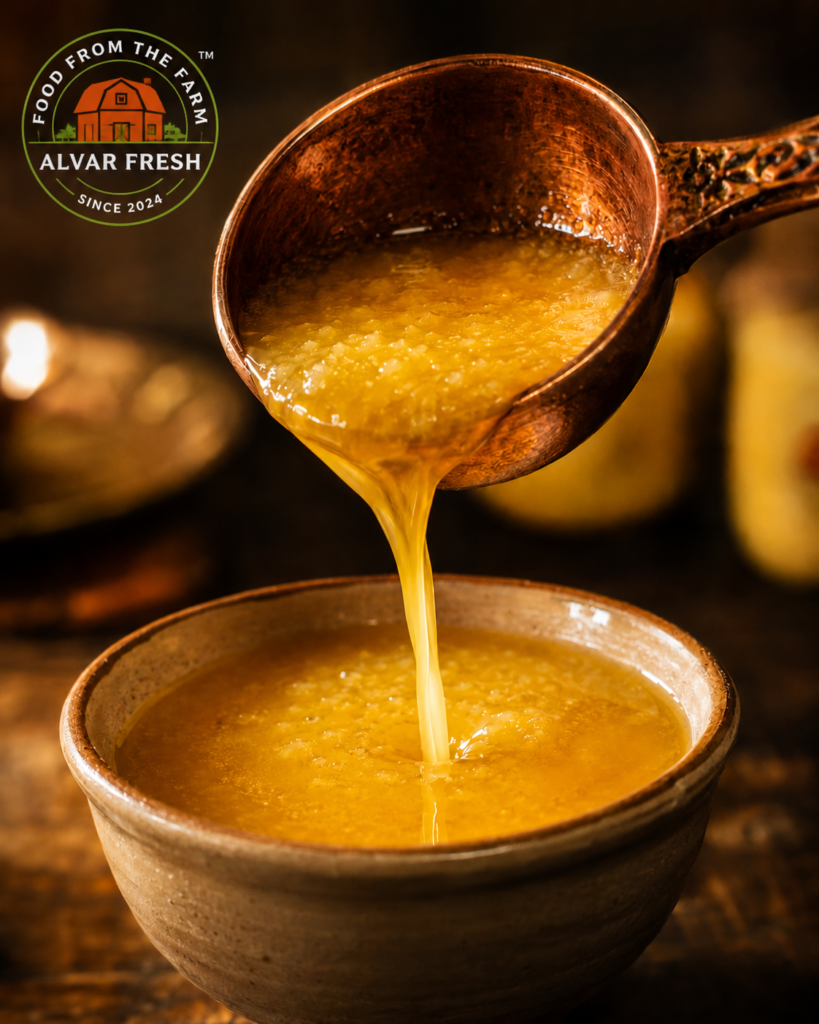
Cow’s milk contains a protein called beta-casein, which exists in two genetic variants: A1 and A2. The type a cow produces is determined entirely by its breed — specifically, by its genetics. This is not something that changes with feed, season, or farming practice. It is fixed at the breed level.
Indigenous Indian cattle breeds — the Gir, Sahiwal, Rathi, Kankrej, Red Sindhi — are A2 producers by nature. These are Bos indicus breeds that evolved on the subcontinent over thousands of years. They carry a proline amino acid at position 67 of the beta-casein chain, which is the defining marker of A2 milk.
Exotic crossbred cattle — Holstein-Friesian, Jersey, and their Indian hybrids — produce A1 milk. These breeds were introduced and scaled up for commercial dairy production because of their higher milk yield. They carry a histidine amino acid at that same position 67, and that single difference changes how the protein behaves inside the human digestive system.
When you break down A1 beta-casein during digestion, it releases a peptide called BCM-7 (beta-casomorphin-7). A2 beta-casein does not produce BCM-7. That is the core biochemical difference — and it is the reason the debate around A1 ghee vs A2 ghee is worth taking seriously.
💡 Go deeper: What Is A2 Ghee — And Why It’s Not the Same as the Jar Sitting in Your Kitchen Right Now
Is A1 Ghee Good for Health? An Honest Answer
Let’s not be dramatic about this. A1 ghee — ghee made from the milk of crossbred or exotic dairy cattle — is not a harmful substance. Millions of people consume it daily without any dramatic consequence. Ghee, regardless of source, contains beneficial short-chain fatty acids, fat-soluble vitamins like A, D, E, and K, and it has a high smoke point that makes it far better for Indian cooking than refined oils.
But the question isn’t whether A1 ghee is dangerous. The question is whether it is as good for you as the alternative — and here, the research gives us reason to pause.
BCM-7, the opioid-like peptide released during the digestion of A1 beta-casein, has been associated in several studies with digestive discomfort, bloating, and inflammatory responses in sensitive individuals. Many people who believe they are lactose intolerant are, in fact, reacting specifically to A1 beta-casein. When they switch to A2 dairy, the symptoms often disappear — without removing dairy from their diet at all.
Beyond digestion, some researchers have flagged BCM-7 as a peptide worth studying in the context of longer-term metabolic health. The evidence is still building, and it would be inaccurate to make absolute claims. But the precautionary logic is simple: if there’s a cleaner option — one that doesn’t produce BCM-7, comes from a traditionally raised Indian breed, and has been consumed here for centuries — why would you settle for the industrial version?
Ghee is not an occasional food in Indian culture. It goes into your morning roti, your child’s khichdi, your evening dal, the ladoos made for every celebration. This is a daily, lifelong food. The quality of that food compounds.
📖 Related: Is Ghee Good for Health? Here Is What Nobody Is Telling You Honestly
Which Ghee Is Better — A2 or A1? Let’s Actually Answer This
Most articles dodge this question. We won’t.
A2 ghee is better — when it is genuinely made from A2 milk, using a proper traditional process, from well-raised indigenous cows. That’s the full sentence. Without each of those conditions being met, you don’t necessarily have a better product just because the label says A2.
When people ask us which is better in the A1 ghee vs A2 ghee comparison, this is what we tell them — the answer is clear, but only when the A2 option is genuinely made right.
Here is what makes authentic A2 ghee superior in practical terms:
Digestibility. The absence of BCM-7 makes A2 ghee easier on the gut, especially for people who experience discomfort after eating regular ghee or other dairy products.
Nutritional quality. Genuine Bilona-method A2 ghee — churned from cultured curd, not cream-separated — retains a richer nutrient profile. The fermentation step preserves beneficial compounds that industrial processing eliminates.
Omega fatty acid ratio. A2 milk from grass-fed indigenous cows has a more favourable omega-3 to omega-6 ratio. This matters because chronic inflammation in modern diets is largely driven by omega-6 excess, and the fats in your ghee contribute to this ratio every single day.
Butyrate content. All ghee contains some butyrate — a short-chain fatty acid that feeds the gut lining and supports colon health. But traditional Bilona-process ghee retains more of it because the slower heat treatment preserves more of the beneficial fat compounds.
None of this means you should panic about your current pantry. It means that when you’re choosing, the better option is clear.
Does Ghee Increase Triglycerides? What the Evidence Actually Says
This question comes up often — and it deserves a careful answer rather than a blanket reassurance.
Ghee is a saturated fat, and saturated fat has historically been blamed for raising triglycerides and LDL cholesterol. But that blanket claim has been revised significantly by more recent nutritional science. Not all saturated fats behave the same way in the body.
The short and medium-chain fatty acids in ghee — particularly butyrate, caproic acid, and caprylic acid — are metabolised differently from the long-chain saturated fats found in processed food. The body uses them as quick energy rather than storing them, and several studies have found that moderate ghee consumption does not significantly raise triglycerides in healthy individuals eating an otherwise balanced diet.
What does raise triglycerides? Refined carbohydrates, excess sugar, trans fats, and sedentary lifestyle — things that are far more common in modern diets than a teaspoon or two of traditional ghee.
Where the triglyceride concern becomes more relevant is in excessive consumption of any fat, including ghee — and in individuals who already have a diagnosed lipid metabolism issue. If you fall into that category, speak to your doctor about appropriate amounts. For everyone else, ghee consumed mindfully, in the quantities that Indian cooking has always used, is not the enemy of your cholesterol panel.
In fact, the butyrate in high-quality A2 ghee has been studied for its role in improving insulin sensitivity and gut barrier function — both of which indirectly support healthy triglyceride metabolism.
The Gir Cow: Why the Breed Behind Your Ghee Matters So Much
India’s Ancient Dairy Breed and What It Carries
When we talk about A2 ghee and authentic Indian ghee traditions, the Gir cow comes up again and again — and for good reason.
The Gir originates from the Gir forest region of Gujarat and is one of the most studied indigenous Indian cattle breeds in the world. It produces milk that is exclusively A2 beta-casein. But beyond the protein type, Gir milk has characteristics that set it apart: a natural golden colour from higher beta-carotene content, a richer fat profile, and a taste that experienced ghee makers describe as distinctly superior.
Gir cows are also known for their Panchagavya significance in Ayurveda — the five sacred products of the cow (milk, curd, ghee, cow dung, and cow urine) that form the basis of traditional healing formulations. The Gir has been central to this tradition for millennia, not as a marketing claim, but as a lived, documented practice.
When you choose ghee made from Gir cow milk, you’re not just choosing a protein variant. You’re choosing a breed that has been optimised by thousands of years of natural selection for exactly the kind of dairy India’s cuisine and Ayurveda were built around.
🐄 Read more: A2 Gir Cow Ghee Benefits: Why This Ancient Breed Produces India’s Finest Ghee
The Bilona Method: Process Is the Other Half of the Quality Equation
Why How the Ghee Is Made Changes Everything
Here’s something the packaged ghee industry doesn’t advertise: even if a brand uses A2 milk from indigenous cows, if the ghee is made through industrial cream separation and high-heat flash processing, you’re getting a nutritionally degraded product.
Traditional ghee-making in India followed the Bilona method — a multi-step, time-intensive process that mirrors what every grandmother who made ghee at home was actually doing.
It starts with whole milk, which is gently heated and then fermented into curd overnight. The curd is churned the next morning — traditionally using a wooden churner (the bilona) moved in both directions — to extract white butter, called makhan. This makhan is then slowly heated on a low flame until the water evaporates and the milk solids separate, leaving behind pure, aromatic ghee.
This process does several important things. Fermentation develops beneficial compounds and changes the fat structure. Slow churning preserves more of the milk’s natural richness. Slow heating avoids the degradation of heat-sensitive nutrients that industrial flash processing destroys.
The result is a ghee that is lighter in texture, more aromatic, slightly granular when cooled (which is normal and actually a good sign), and noticeably more bioavailable.
🔗 Dive deeper: The Bilona Method: The Ancient Ghee-Making Process That Changes Everything
A1 Ghee vs A2 Ghee: A Side-by-Side That Actually Tells You Something
A1 Ghee vs A2 Ghee — Side by Side
Alvar Fresh · Know what’s in your jar before you buy
| Factor | 🥛 A1 Ghee | 🌿 A2 Ghee (Bilona) |
|---|---|---|
| Milk Source | Crossbred / exotic breeds (HF, Jersey) |
Indigenous breeds (Gir, Sahiwal, Kankrej) |
| Beta-Casein Type | A1 | A2 |
| BCM-7 Peptide |
⚠ Present Released during digestion |
✔ Absent Not produced |
| Digestibility | May cause discomfort in sensitive individuals | Generally easier to digest for most people |
| Omega-3 Content | Lower | Higher (especially from grass-fed cows) |
| Butyrate Retention | Standard | Higher with Bilona process |
| Production Method | Typically cream-separated, industrial | Traditional curd-churning (Bilona) |
| Colour & Texture | Pale yellow, smooth, fully liquid | Richer golden hue, slightly grainy when cooled |
| Price Point | Lower | Higher (due to breed, process & yield) |
| Best Suited For | General bulk cooking | Daily family consumption, health-focused use |
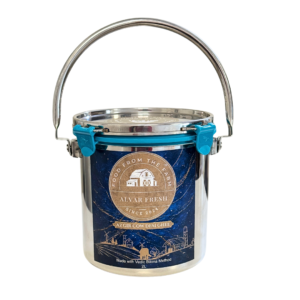
🛒 Alvar Fresh A2 Gir Cow Ghee — Made the Way It Should Be
-
Alvar Fresh Bilona Desi Ghee – 1L
Original price was: ₹1,950.00.₹1,650.00Current price is: ₹1,650.00. -
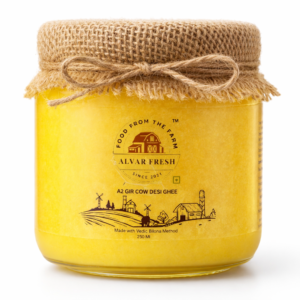
Alvar Fresh Bilona Desi Ghee – 250 ML
Original price was: ₹699.00.₹450.00Current price is: ₹450.00. -
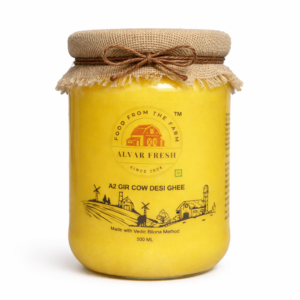
Alvar Fresh Bilona Desi Ghee – 500 ML
Original price was: ₹1,100.00.₹840.00Current price is: ₹840.00. -
Alvar Fresh Bilona Desi Ghee – 2L
Original price was: ₹3,850.00.₹3,750.00Current price is: ₹3,750.00.
What Nobody Actually Tells You Before You Buy “A2 Ghee”
The labelling in the Indian ghee market is, to put it plainly, messy. A brand can put “A2 ghee” on their packaging as long as the milk technically comes from a cow that produces A2 beta-casein. But that’s where the standard ends — and where the consumer’s due diligence needs to begin.
Here’s what’s often missing from the A2 label:
Breed specificity. “Desi cow ghee” is not the same as “Gir cow ghee.” There are multiple indigenous breeds in India, and while most produce A2 milk, they vary in the quality and fat composition of that milk. Ask which breed.
Farming practices. A Gir cow kept in a concrete stall, fed processed feed, and milked beyond her natural capacity is not producing the same milk as a Gir cow grazing on natural pasture and milked only after her calf has fed. The living conditions of the cow directly affect the milk.
Process transparency. Many brands that claim Bilona process actually use a hybrid approach — cream separation followed by a short churning step for texture. Real Bilona starts from whole milk curd, not cream.
Fat source. Authentic Bilona ghee comes from the butter extracted by churning cultured curd. Some brands mix in cream butter and call it Bilona. The flavour, nutritional profile, and gut behaviour of these two products are different.
The only way to know is to ask, and to buy from brands that answer those questions directly and honestly.
📖 Related:
How to Identify Real A2 Bilona Ghee at Home
You don’t need a lab to tell the difference in the A1 ghee vs A2 ghee debate — your senses are a surprisingly good guide. These simple checks go a long way:
Colour: Authentic A2 Gir cow Bilona ghee has a deep golden-yellow hue. This comes from the higher beta-carotene content in Gir cow milk. Pale, almost white ghee usually indicates low-quality milk or industrial processing.
Texture at room temperature: Good Bilona ghee has a slightly grainy, sandy texture when cooled. If it’s perfectly smooth and glossy like a commercial product, it has likely been over-processed or cream-separated.
Aroma: Real ghee smells nutty, rich, and distinctly dairy — not flat or artificially flavoured. The curd fermentation step in Bilona processing gives it a depth that industrial ghee simply doesn’t have.
Melt behaviour: Pour a small amount on your palm. Authentic Bilona ghee melts at body temperature almost immediately. Industrial ghee tends to feel greasier and slower to melt.
Float test: Drop a small amount in cold water. Pure ghee will solidify in a single mass. Adulterated ghee may float in layers or dissolve unevenly.
📖 Read: Pure Desi Ghee: How to Identify, Choose & Never Get Fooled Again
Ghee vs Butter: A Quick Note for Those Switching
Some people transitioning to cleaner fats ask whether butter is a reasonable alternative to ghee. The short answer: no, and here’s why.
Butter retains milk solids and water. Ghee is clarified — which means the milk solids and water are removed, leaving only the pure fat. For people with dairy sensitivities (casein or lactose), ghee is far more tolerable than butter. Ghee also has a significantly higher smoke point, making it safe for Indian cooking temperatures where butter would burn and produce harmful free radicals.
A2 Bilona ghee takes this further still — it’s made from curd-fermented butter (not cream butter), which means even more of the lactose and casein proteins are broken down before the ghee is made.
📖 Read: Ghee vs Butter: The Honest Answer Your Kitchen Has Been Waiting For
🛒 Try Alvar Fresh — Our Most Loved Pack
-
Alvar Fresh Bilona Desi Ghee – 1L
Original price was: ₹1,950.00.₹1,650.00Current price is: ₹1,650.00. -
Alvar Fresh Bilona Desi Ghee – 250 ML
Original price was: ₹699.00.₹450.00Current price is: ₹450.00. -
Alvar Fresh Bilona Desi Ghee – 500 ML
Original price was: ₹1,100.00.₹840.00Current price is: ₹840.00. -
Alvar Fresh Bilona Desi Ghee – 2L
Original price was: ₹3,850.00.₹3,750.00Current price is: ₹3,750.00.
The Best Ghee in India: How to Apply All of This
If you’ve read this far, you already know more than most ghee buyers in India. Here’s how to turn that knowledge into a better purchase decision.
Step 1: Start with the breed. Look for Gir, Sahiwal, Kankrej, or Rathi — named specifically. “Desi cow” without breed specificity is a vague claim.
Step 2: Check the process. Bilona or hand-churned from curd is what you want. Cream-separated, however traditional the packaging looks, is a different product.
Step 3: Ask about the farm. Can the brand trace the milk? Do they have a relationship with the dairy farmers? Transparent sourcing is a mark of genuine quality commitment.
Step 4: Read the ingredient list. Pure ghee should have one ingredient: ghee. Any additives — stabilisers, flavours, colour agents — are red flags.
Step 5: Trust your senses. Colour, texture, aroma — these tell you a lot once you know what to look for (see the section above).
📖 Related:
Conclusion: The A1 Ghee vs A2 Ghee Choice Is Simpler Than It Seems
Somewhere along the way, the Indian dairy industry traded the ancient Gir for the high-yield Holstein, and most kitchens followed without realising the swap had happened. The discussion around A1 ghee vs A2 ghee is really a discussion about going back to what was always there — before yield became more important than quality.
If you’re using ghee every day, it’s worth using the right one. A2 ghee from a named indigenous breed, made through the Bilona process, from ethically raised and properly fed cows — this is not a premium indulgence. It is what ghee was always meant to be.
The jarful sitting in most Indian kitchens right now probably isn’t that. Changing it is simpler than it sounds.
At Alvar Fresh, we make A2 Gir Cow Ghee the traditional way — no shortcuts, no ambiguity, and no compromise on the source. If you’re ready to make the switch, explore our range here.
Further Reading to Complete Your Ghee Education:
- What Is A2 Ghee — And Why It’s Not the Same as the Jar Sitting in Your Kitchen Right Now
- A2 Gir Cow Ghee Benefits: Why This Ancient Breed Produces India’s Finest Ghee
- Is Ghee Good for Health? Here Is What Nobody Is Telling You Honestly
- The Best Ghee in India: What to Actually Look For Beyond the Label
- Ghee vs Butter: The Honest Answer Your Kitchen Has Been Waiting For
- Pure Desi Ghee: How to Identify, Choose & Never Get Fooled Again