My grandmother never once read a nutrition label. She just knew which ghee was good and which was not. She could tell by the smell, the color, even the way it melted in the pan. And the ghee she used every single day — without exception — came from the family’s Gir cow. Nobody called it A2 cow ghee back then. It was just ghee. The real kind.
Fast forward to today and suddenly everyone is talking about A2. Brands are printing it in bold on their packaging. Influencers are swearing by it. Your neighbor who just started eating clean will not stop mentioning it. But here is what frustrates me — very few people actually explain what it means. They just throw the term around like it is self-explanatory. If you are still figuring out what real ghee even looks like, we have a full guide on how to identify pure desi ghee that is worth reading first.
So let us actually talk about it. What makes A2 cow ghee different, whether it genuinely lives up to the hype, and how you can tell if what you are buying is the real thing or just clever labeling.
“Your grandmother did not have lab reports or protein charts. She just knew that ghee from a desi cow hit differently — in your stomach, in your energy, in how food tasted. Turns out, she was right all along.”
So What Exactly Is A2 in Cow Ghee?
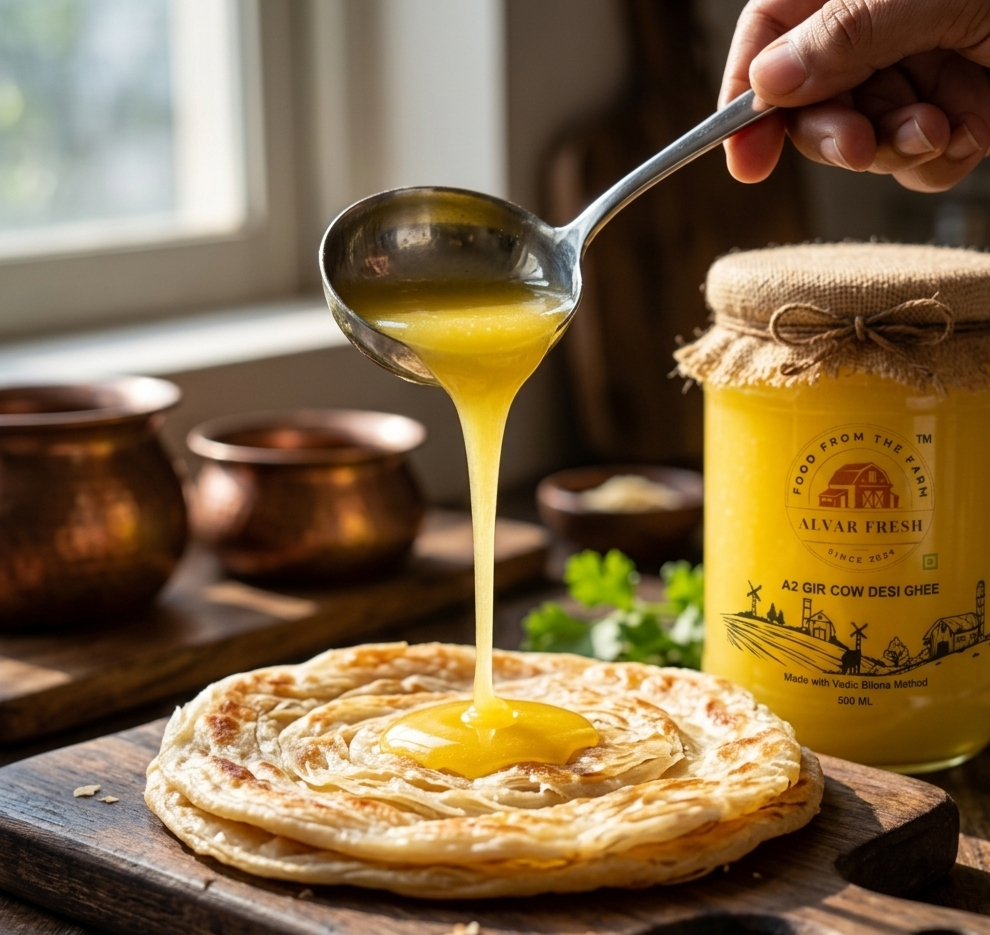
Here is the part where most articles go full science mode and lose everyone. I will keep it simple.
Cow milk has protein in it. One of the main proteins is called beta-casein. Now, beta-casein comes in two forms — A1 and A2. Every cow carries genes that determine which type of beta-casein her milk contains. Some cows produce A1, some produce A2, and some produce a mix of both. It all comes down to genetics and breed.
When you drink or consume A1 milk, your digestive system breaks it down and — in many people — produces a compound called BCM-7. Think of BCM-7 as a small protein fragment that the gut was never really designed to deal with comfortably. For a lot of people, especially those who feel bloated or heavy after consuming dairy, BCM-7 is the actual culprit — not lactose.
A2 cow ghee is made from milk that contains only A2 beta-casein. No BCM-7 gets produced during digestion. The body handles it more naturally, more smoothly — the way dairy was meant to be digested before modern crossbreeding changed the genetic makeup of commercial cattle.
The one-line version
A2 is a naturally occurring protein in desi cow milk that your gut handles much better than the A1 protein found in most commercial dairy. A2 cow ghee is simply ghee made from that gentler milk — and your stomach notices the difference.
Is A2 Ghee Actually Better or Just Better Marketing?
Fair question. And I want to answer it honestly rather than just telling you what you want to hear.
The research on A2 dairy is still growing. It is not the kind of settled science where every expert agrees. But what we do have — multiple clinical studies, decades of traditional use, and a whole lot of first-hand experience from people who have made the switch — points consistently in one direction. A2 cow ghee genuinely is easier on the body for most people, and it carries a richer nutritional profile when made from the right cows using the right process.
What Your Gut Notices First
If you have ever eaten a big ghee-heavy meal and felt uncomfortably full or bloated afterward, there is a good chance A1 protein played a role. People who switch to A2 cow ghee very commonly report that the heaviness just disappears. Meals feel lighter. Digestion feels easier. The food sits well instead of sitting heavy.
This is not a placebo. When BCM-7 is out of the picture, your gut simply does not have to work as hard. And for people who have been quietly assuming they just cannot tolerate dairy well, discovering A2 cow ghee can genuinely feel like a revelation.
The Nutritional Side of Things
Beyond how it feels in your stomach, A2 cow ghee made from indigenous Indian breeds is genuinely richer in the things that matter. We are talking about higher concentrations of Omega-3 fatty acids, CLA — a fat that research has linked to better metabolism and reduced inflammation — and fat-soluble vitamins like A, D, E, and K2 that your body can only absorb alongside fat. The deep golden color you see in good quality ghee? That comes from beta-carotene, which is also an antioxidant. It is not an aesthetic feature — it is a nutritional indicator.
But What Does the Science Actually Say?
Clinical trials comparing A1 and A2 dairy consumption have found real, measurable differences in digestive comfort and markers of gut inflammation. A notable study published in the European Journal of Clinical Nutrition found that people consuming A2 milk reported significantly less bloating and discomfort compared to those on A1 milk — even among individuals who believed they were lactose intolerant. The problem, it turned out, was never the lactose. It was the protein.
Does that mean A2 cow ghee is a miracle product? No. But for something consumed daily — added to your dal, spread on your roti, stirred into your morning coffee — even a small difference in how your body processes it adds up meaningfully over months and years.
What the research broadly supports
Easier digestion for most people · Less bloating vs A1 dairy · Better absorption of fat-soluble vitamins · Potential anti-inflammatory benefits · Higher Omega-3 and CLA content in grass-fed desi cow ghee
A1 vs A2 — Which One Is Worth Your Money?
Let me be direct here. If you are choosing between A1 and A2 cow ghee and both are made well, A2 is the better choice. Not because of a trend, but because the protein structure of A2 milk is closer to what the human digestive system has co-evolved with over thousands of years — long before commercial crossbreeding entered the picture.
That said — A1 ghee is not poison. If that is what your grandmother used and it never bothered you, your genetics may simply process it fine. But if you have ever had a nagging feeling that something in your diet was not sitting right, switching to A2 cow ghee is one of the simplest and most impactful changes you can make.
Best Sellers
-
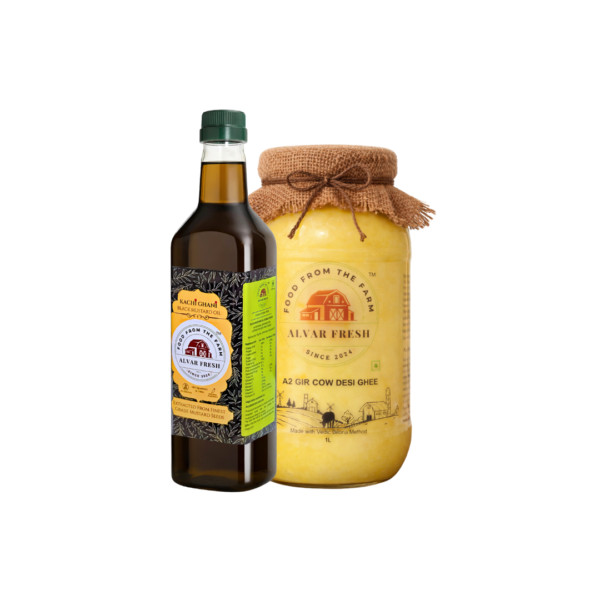
Alvar Fresh A2 Ghee 1Ltr & Mustard Oil 1Ltr
Original price was: ₹2,249.00.₹1,850.00Current price is: ₹1,850.00. -
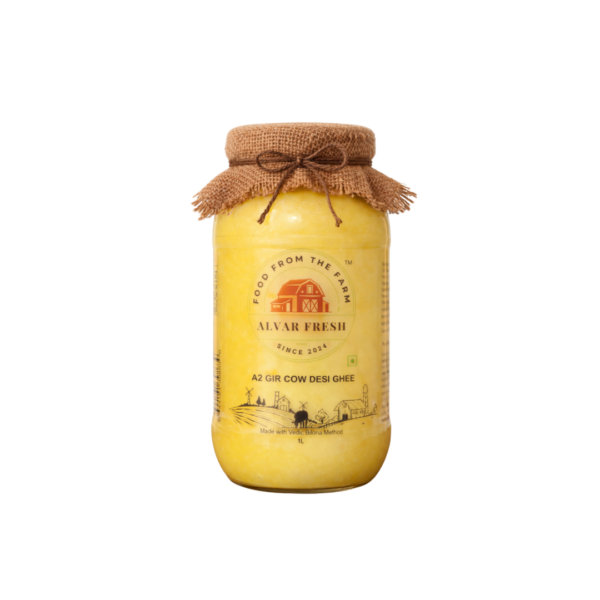
Alvar Fresh Bilona Desi Ghee – 1L
Original price was: ₹1,950.00.₹1,650.00Current price is: ₹1,650.00. -
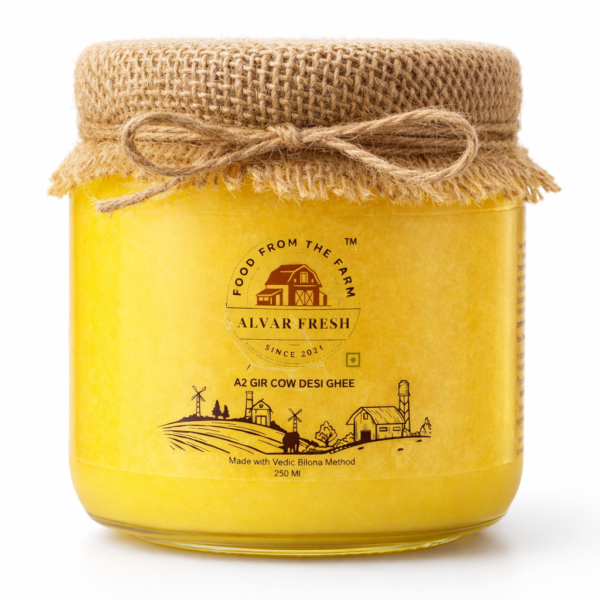
Alvar Fresh Bilona Desi Ghee – 250 ML
Original price was: ₹699.00.₹450.00Current price is: ₹450.00. -
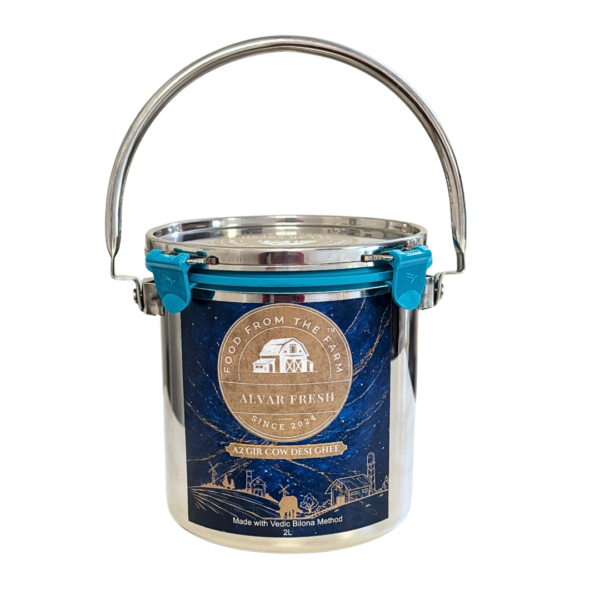
Alvar Fresh Bilona Desi Ghee – 2L
Original price was: ₹3,850.00.₹3,750.00Current price is: ₹3,750.00.
Processing Matters Just as Much as Protein
Here is something brands do not always want you to think about: the source of the milk is only half the story. Even genuine A2 milk can produce mediocre ghee if it goes through industrial cream-separation and high-heat processing. The traditional Bilona method — where the milk is first cultured into curd, hand-churned to extract butter, and then slow-cooked on a low flame — is what actually preserves everything that makes A2 cow ghee worth paying for. Without the right process, you are just buying the label.
Are Indian Cows A1 or A2? Here Is the Truth
This is one of those facts that tends to genuinely surprise people — and it should, because it completely changes how you think about Indian dairy.
Our indigenous Indian cow breeds are naturally A2. They have always been. Gir, Sahiwal, Tharparkar, Rathi, Kankrej — these cows have been producing A2 milk on Indian soil for thousands of years. They were never selectively bred for volume. They were raised for sustenance, for nourishment, for the quality of what they gave — not the quantity.
So Where Did A1 Come From in India?
The trouble started when India began large-scale crossbreeding programs in the mid-20th century, pairing native cows with high-yield foreign breeds like Holstein-Friesian to increase milk output. The economics made sense at the time. But the nutritional trade-off was quietly enormous. Today, a significant portion of commercial milk in India comes from crossbred cows that carry A1 genetics. The shelves are full of it. Most people have no idea.
This is exactly why the breed behind your A2 cow ghee matters so much. A jar that says “cow ghee” tells you almost nothing. A jar that tells you it comes from Gir or Sahiwal cows, raised on natural pasture, processed using the Bilona method — that tells you something real.
Every single one of these breeds is naturally A2. And every one of them has been a part of Indian food culture for longer than most civilizations have existed. When Ayurvedic texts talked about the healing properties of ghee, they were not talking about ghee in the abstract. They were talking about ghee made from exactly these animals.
A quick way to verify before you buy
Ask the brand which breed they use · Look for named indigenous breeds, not vague “desi cow” claims · Check if the color is genuinely golden-yellow · Ask whether the Bilona method is used · If the brand cannot answer these questions, that is your answer
How to Actually Find Genuine A2 Cow Ghee
The demand for A2 cow ghee has exploded over the last few years — and predictably, so has the number of brands making the claim without the substance to back it up. Here is what separates the real thing from the rest.
Traceability Is Non-Negotiable
A brand that genuinely makes A2 cow ghee can tell you exactly where their milk comes from. Which breed. Which farms. What the cows eat. How many litres of milk it takes to make one jar. These are not vanity details — they are proof of process. If a brand gets vague when you start asking these questions, treat that vagueness as a red flag.
Your Senses Are More Reliable Than You Think
Open a jar of good A2 cow ghee and the smell alone will tell you something. It should be warm, nutty, almost caramel-like — the kind of smell that makes you think of a kitchen where something wonderful is being cooked. If it smells flat, sharp, or artificial, something went wrong somewhere in the process.
The color should be a clear, confident golden-yellow — not pale, not white, not murky. In cooler weather, genuine A2 cow ghee will develop a slightly grainy or crystalline texture as the fats solidify naturally. This is not a defect. It is one of the most reliable signs that nothing artificial has been added to keep it smooth.
Read Past the Label
The word A2 on a label costs a brand nothing to print. What costs them something is actually sourcing from indigenous breeds, working with small farms, and using a slow traditional process instead of an industrial one. Look for brands that talk about their process in detail — not just their claims. The story behind the ghee is usually the most honest indicator of what is inside the jar.
From our kitchen to yours
At [Your Brand Name], our A2 cow ghee comes from pasture-raised Gir cows — one of India’s oldest and most revered indigenous breeds. Every batch goes through the traditional Bilona process. We work directly with small family farms because we believe the relationship between the farmer, the cow, and the ghee matters. When you open a jar of ours, you will smell the difference immediately. That is not marketing. That is just what real ghee smells like.
Final Thoughts
Here is what I want you to take away from all of this. A2 cow ghee is not a trend that will fade by next year. It is a return — to the way Indian dairy was always meant to be, before commercial pressures changed the game. The breeds, the process, the nutrition — none of this is new. We are just rediscovering it.
If your body has ever felt like it did not quite agree with regular dairy, give A2 cow ghee a genuine try. Not a week. Give it a month of daily use. Pay attention to how your digestion feels, how your energy holds through the day, how food tastes when it is cooked in something that actually belongs in the pan.
My grandmother never needed a blog post to tell her which ghee was worth using. But she also had a Gir cow in the backyard. The rest of us have to do a little more homework — and hopefully, this was a good place to start.