
There is a jar of ghee sitting in most Indian kitchens right now. It probably says “pure” on the label. It might even say “desi cow” or “A2.” But here is the question almost nobody thinks to ask — how was it actually made? Because when it comes to ghee, the process matters just as much as the source. And the bilona method is the process that separates genuinely nourishing ghee from everything else on the shelf.
Most people have never heard of the bilona method. They know ghee. They have grown up with it. But the specific way in which ghee is made — and how dramatically that process affects the final product — is something the commercial dairy industry has very little interest in drawing attention to. Because the bilona method is slow, labour-intensive, and impossible to scale cheaply. It cannot be rushed. It cannot be automated without losing what makes it valuable. And that is precisely why it produces ghee that no factory line can replicate.
This post is about the bilona method — what it is, how it works, why it matters nutritionally, and how to tell whether the ghee you are buying was actually made this way or is just using the label.
“The bilona method is not a technique. It is a philosophy — one that says slowing down and doing something properly is always worth more than doing it fast and cheap. Every jar of ghee made this way carries that intention in it.”
What Is the Bilona Method?
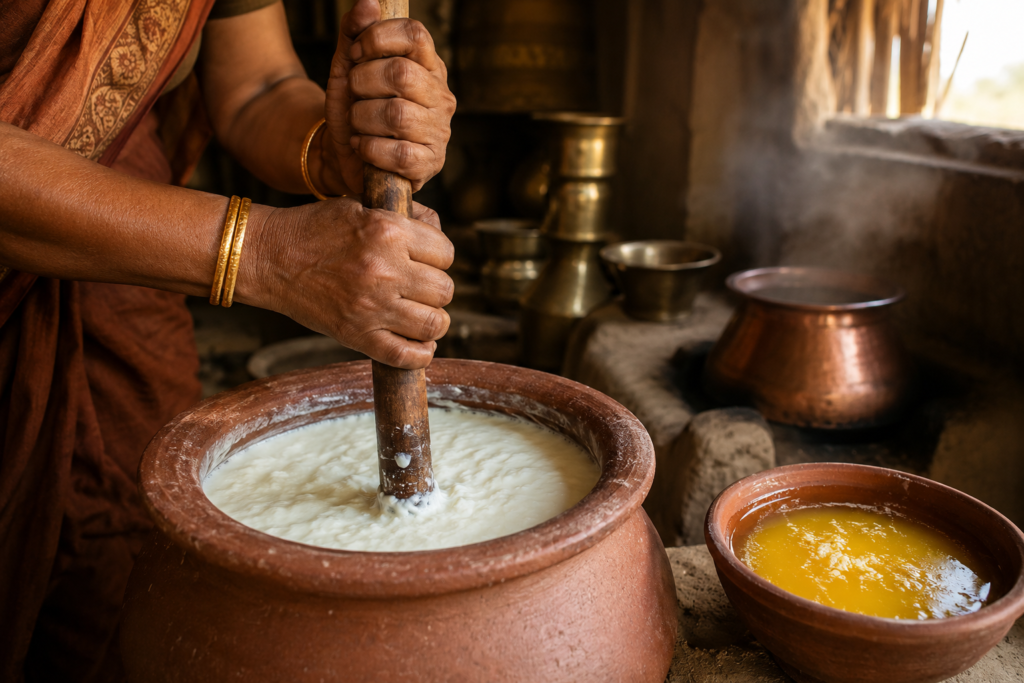
The bilona method is the traditional Indian process of making ghee from whole milk by first converting it into curd, then hand-churning the curd to extract butter, and finally slow-cooking that butter on a low flame until pure clarified ghee remains. Every single step is done slowly, intentionally, and without shortcuts. That is the bilona method in its simplest description — but understanding why each step matters is what makes the whole picture clear.
The word bilona itself refers to the wooden hand churner — a long wooden rod with a disc at the bottom — that has been used in Indian homes for thousands of years. The churning motion is rhythmic and gentle. It does not violently separate fat from liquid the way mechanical processing does. It coaxes the butter out of the curd slowly, which preserves the integrity of the fat molecules in a way that high-speed industrial churning simply cannot match.
The Bilona Method Step by Step
Here is exactly how the bilona method works from start to finish — because understanding the process helps you appreciate why the result is so different from commercially made ghee.
- Whole milk collection
Fresh whole milk is collected from indigenous desi cows — ideally Gir or Sahiwal — grazed on open pasture. The quality of this milk is the foundation of everything the bilona method produces.
2. Boiling and cooling
The milk is gently boiled and then cooled to the right temperature — warm enough for the culture to work, but not so hot that it kills it.
3. Curd setting — overnight fermentation
A small amount of curd culture is added and the milk is left overnight to ferment into curd. This is the most nutritionally significant step in the bilona method — the fermentation creates a probiotic environment that transforms the fat profile of the final ghee.
4. Hand churning with the wooden bilona
The next morning, the curd is hand-churned using the traditional wooden churner until butter separates and rises to the surface. This slow churning is what gives the bilona method its name — and its nutritional advantage.
5. Butter collection
The butter — called makhan — is carefully scooped from the surface and collected. The remaining liquid, chaach, is a natural probiotic buttermilk that is consumed separately.
6. Slow cooking into ghee
The makhan is placed in a heavy-bottomed pan and slow-cooked on a very low flame. The water evaporates gradually, the milk solids settle and are strained out, and pure golden ghee remains. The bilona method demands patience at every step — but especially here.
Why the curd step is the real secret
Most people assume the bilona method is just about hand-churning. But the overnight curd fermentation is equally important. When milk ferments into curd before churning, the fat structure changes in ways that make the resulting ghee easier to digest, richer in butyric acid, and more bioavailable nutritionally. Skip this step — as industrial processing does — and you lose the most important nutritional advantage the bilona method provides.
What Is the Difference Between Normal Ghee and Bilona Ghee?
This is the question most people come to after learning about the bilona method for the first time — and it deserves a thorough answer, because the differences are not just about process. They show up in color, smell, texture, nutritional profile, and the way the ghee behaves in your body.
What most of us grew up calling “normal ghee” — the kind produced commercially at scale — is made using a completely different method called cream separation. In this process, cream is mechanically separated from milk at high speed, then directly churned or heated into ghee without any curd fermentation step. It is faster, cheaper, and produces a consistent-looking product. But it is nutritionally a very different thing from ghee made using the bilona method.
Bilona Method Ghee
✦ Whole milk → curd → butter → ghee
✦ Overnight fermentation step included
✦ Hand-churned slowly and gently
✦ Deep golden-yellow color naturally
✦ Rich, complex nutty aroma
✦ Higher butyric acid and CLA content
✦ More fat-soluble vitamins preserved
✦ Easier on digestion for most people
✦ Slightly grainy in cold weather
Normal Commercial Ghee
· Cream separated mechanically from milk
· No fermentation step
· High-speed mechanical processing
· Pale yellow or off-white color
· Flat or mildly artificial smell
· Lower butyric acid and CLA
· Heat-sensitive vitamins partly lost
· Heavier on digestion for some
· Uniformly smooth in all weather
The Nutritional Gap Nobody Talks About
The most significant difference between normal ghee and ghee made using the bilona method is not something you can see with your eyes — it is in the nutritional composition. Because the bilona method starts with fermented curd rather than raw cream, the fat that eventually becomes ghee has gone through a biological transformation. The fermentation process increases the concentration of butyric acid — the short-chain fatty acid that feeds the gut lining and supports digestive health. It preserves more of the fat-soluble vitamins A, D, E, and K2 that are present in the original milk. And it produces a fat profile that research suggests is more bioavailable — meaning your body can actually use more of what is in the ghee rather than simply processing it as generic saturated fat.
What You Notice in the Kitchen
Beyond nutrition, the differences between the bilona method and commercial ghee are things you can actually observe and taste. Bilona ghee has a deeper, warmer golden color that comes from beta-carotene naturally present in desi cow milk. It smells rich and complex — nutty, slightly caramel-like, the kind of smell that fills a kitchen in a way that feels genuinely comforting rather than merely oily. And in cooler weather, it develops a slightly grainy crystalline texture as the natural fats solidify — which is a purity indicator, not a defect. Commercial ghee, stabilized by its processing and sometimes by additives, stays uniformly smooth regardless of temperature.
How Much Milk Does the Bilona Method Require?
This is one of the reasons why genuine bilona method ghee costs what it costs — and why suspiciously cheap “bilona ghee” should always raise questions. To make one litre of ghee using the bilona method, it takes approximately 25 to 30 litres of whole milk. Commercial cream-separated ghee requires significantly less, because cream is more fat-dense than whole milk and requires less starting material. The yield difference is enormous — and it is why the bilona method is inherently a small-batch, high-investment process.
📖 Related read
Pure Desi Ghee: How to Identify, Choose & Never Get Fooled Again
Now that you know what the bilona method produces, this guide will help you identify whether the ghee in your hands was actually made this way — at home, before you buy.
Read the full guide →
Why Large Brands Cannot Use the Bilona Method
It is worth understanding why this is not simply a choice large dairy brands make — it is a structural impossibility at their scale. The bilona method requires approximately 25 to 30 litres of whole milk per litre of ghee, overnight fermentation time, and genuine hand-churning labour. For a brand operating at Amul’s scale, producing even a fraction of their daily ghee output using the bilona method would require thousands of trained workers and an infrastructure that makes no commercial sense. The bilona method is inherently artisanal. It belongs to small farms, small batches, and producers who have made a conscious decision to prioritise quality over volume. That is not a criticism of large brands — it is simply the reality of what the bilona method demands.
How to Verify If a Brand Genuinely Uses the Bilona Method
With the rising demand for bilona ghee, a growing number of smaller brands have started using the bilona method label without necessarily following the full process. Here is how to verify whether a brand is genuinely using it. Ask them directly: do they start with whole milk or cream? If the answer is cream, it is not the bilona method regardless of what the label says. Ask whether there is a curd fermentation step overnight. Ask what they do with the chaach — the buttermilk byproduct — because genuine bilona method production always yields this as a natural byproduct. A brand that cannot answer these questions clearly is a brand worth approaching with caution.
Quick verification checklist for bilona method ghee
Starts with whole milk — not cream · Includes overnight curd fermentation · Uses hand-churning to separate butter · Produces chaach as a natural byproduct · Slow-cooked on low flame — not high heat · Brand can name the cow breed and farm source
🔍 Go deeper
The Best Ghee in India: What to Actually Look For Beyond the Label
Process is just one part of finding genuinely good ghee. This guide covers breed, sourcing, and transparency — everything that separates real bilona method ghee from clever packaging.
Read the full guide →
बिलोना विधि क्या है? — For Our Hindi-Speaking Readers
Hindi Section — बिलोना विधि की सरल व्याख्या
बिलोना विधि घी बनाने की वह पारंपरिक भारतीय प्रक्रिया है जिसमें पूरे दूध को पहले दही में बदला जाता है, फिर उस दही को लकड़ी के बिलोने से मथकर मक्खन निकाला जाता है, और उसके बाद उस मक्खन को धीमी आंच पर पकाकर शुद्ध घी तैयार किया जाता है।
बिलोना विधि से बना घी आम क्रीम-सेपरेटेड घी से इसलिए अलग होता है क्योंकि इसमें दही के किण्वन (fermentation) की प्रक्रिया होती है जो घी में ब्यूटिरिक एसिड की मात्रा बढ़ाती है और उसे पाचन के लिए बेहतर बनाती है। इसका रंग गहरा सुनहरा पीला होता है, खुशबू समृद्ध और अखरोट जैसी होती है, और ठंड में यह थोड़ा दानेदार हो जाता है — जो इसकी शुद्धता की निशानी है।
Alvar Fresh का हर बैच इसी बिलोना विधि से तैयार किया जाता है — गिर गाय के दूध से, बिना किसी मिलावट के।
सामान्य घी और बिलोना घी में क्या अंतर है?
सामान्य घी क्रीम सेपरेशन विधि से बनाया जाता है जिसमें दूध से क्रीम को मशीन से अलग करके सीधे घी बनाया जाता है। इसमें दही बनाने या मथने की प्रक्रिया नहीं होती। जबकि bilona method से बना घी पूरे दूध से दही बनाकर, उसे मथकर मक्खन निकालकर, और फिर धीमी आंच पर पकाकर तैयार किया जाता है।
इस फर्क का सीधा असर घी की पोषण गुणवत्ता पर पड़ता है। bilona method से बने घी में ब्यूटिरिक एसिड, CLA, और वसा में घुलनशील विटामिन की मात्रा अधिक होती है। यही कारण है कि आयुर्वेद में हमेशा से बिलोना विधि के घी को सबसे श्रेष्ठ माना गया है।
📘 Also worth reading
A2 Cow Ghee: What Nobody Actually Tells You Before You Buy
The bilona method works best when the milk behind it is genuinely A2. This post explains what A2 means, which Indian breeds produce it, and why the combination of A2 milk and bilona method produces the finest ghee available.
Read the full guide →
Why the Bilona Method Is Worth Every Extra Rupee
The honest conversation about the bilona method always comes around to price eventually — because ghee made this way costs more than commercial ghee, and it always will. The question is whether the difference is worth it. And for most people who have made the switch, the answer is unambiguously yes.
Think about what you are actually getting when you buy ghee made using the bilona method. You are getting 25 to 30 litres of whole milk — from a named indigenous breed, grass-fed on open pasture — that has been cultured overnight, hand-churned by a person who knows what they are doing, and slow-cooked with patience and attention. The labour alone, before you even factor in the milk volume, is substantial. The bilona method is not priced the way it is because of branding. It is priced the way it is because of reality.
The Bilona Method and Ayurveda
It is worth noting that the bilona method is not a modern wellness discovery. Ayurvedic texts written thousands of years ago specified this exact process — starting from whole milk, fermenting into curd, churning to extract butter — as the correct way to produce ghee for therapeutic and nutritional use. When ancient practitioners prescribed ghee as medicine, they were prescribing ghee made using the bilona method. The benefits attributed to ghee in Ayurveda — gut healing, cognitive support, joint lubrication, energy — are benefits attributed to this specific product, made this specific way. Commercial cream-separated ghee is a different product wearing the same name.
The Bilona Method and Sustainability
One final dimension of the bilona method that rarely gets discussed: it is inherently more sustainable than industrial ghee production. Because it works with small indigenous breed herds raised on natural pasture rather than large factory-farming operations, the bilona method supports traditional farming communities, preserves indigenous cow breeds that are increasingly at risk, and produces food in a way that does not depend on industrial inputs or intensive farming practices. Choosing ghee made using the bilona method is not just a health decision — it is a small but meaningful choice about the kind of food system you want to support.
What genuine bilona method ghee always delivers
Deeper golden color from natural beta-carotene · Richer more complex aroma from slow cooking · Higher butyric acid for gut health · More fat-soluble vitamins preserved · Easier digestion for most people · Grainy texture in cold weather — a natural purity sign
Final Thoughts
The bilona method is not complicated. It is just slow — and in a world that has optimised almost everything for speed and scale, that slowness is exactly what makes it valuable. Every step in the bilona method exists for a reason. The fermentation enhances nutrition. The hand-churning preserves the fat. The slow cooking retains the vitamins. None of it is ceremony. All of it is function.
When you understand the bilona method, you understand why two jars of ghee with the same label can be completely different products. You understand why color, aroma, and texture matter. You understand why the price of genuine bilona ghee is what it is — and why it is worth it.
At Alvar Fresh, the bilona method is not a marketing claim. It is the only way we make ghee. Gir cow milk. Overnight curd fermentation. Hand-churning. Slow cooking. Small batches. Every single time. Because we genuinely believe there is no other way to make ghee that deserves to be called the real thing.