
There is a debate that plays out in Indian kitchens, nutritionist offices, and fitness forums every single day — and it almost always ends without a satisfying answer. Ghee vs butter: which one belongs in a healthy kitchen? Which one is better for cooking? Which one is going to make your cardiologist raise an eyebrow?
I have seen people switch from ghee to butter because a Western diet trend told them to, then switch back to ghee six months later because their digestion fell apart. I have seen others avoid both entirely out of a blanket fear of saturated fat — only to discover that the cooking oils they replaced them with were doing far more damage. The ghee vs butter debate deserves a real answer, not a trend-driven one.
So let us actually settle this. Not with diet culture talking points, but with what the research says, what traditional wisdom knew long before the research caught up, and what your body is most likely trying to tell you every time you cook.
“Ghee vs butter is not really a debate about which fat is bad. It is a debate about which fat your body was designed to handle better — and that answer has been sitting in Indian kitchens for thousands of years.”
Ghee vs Butter: What Are They Actually Made Of?
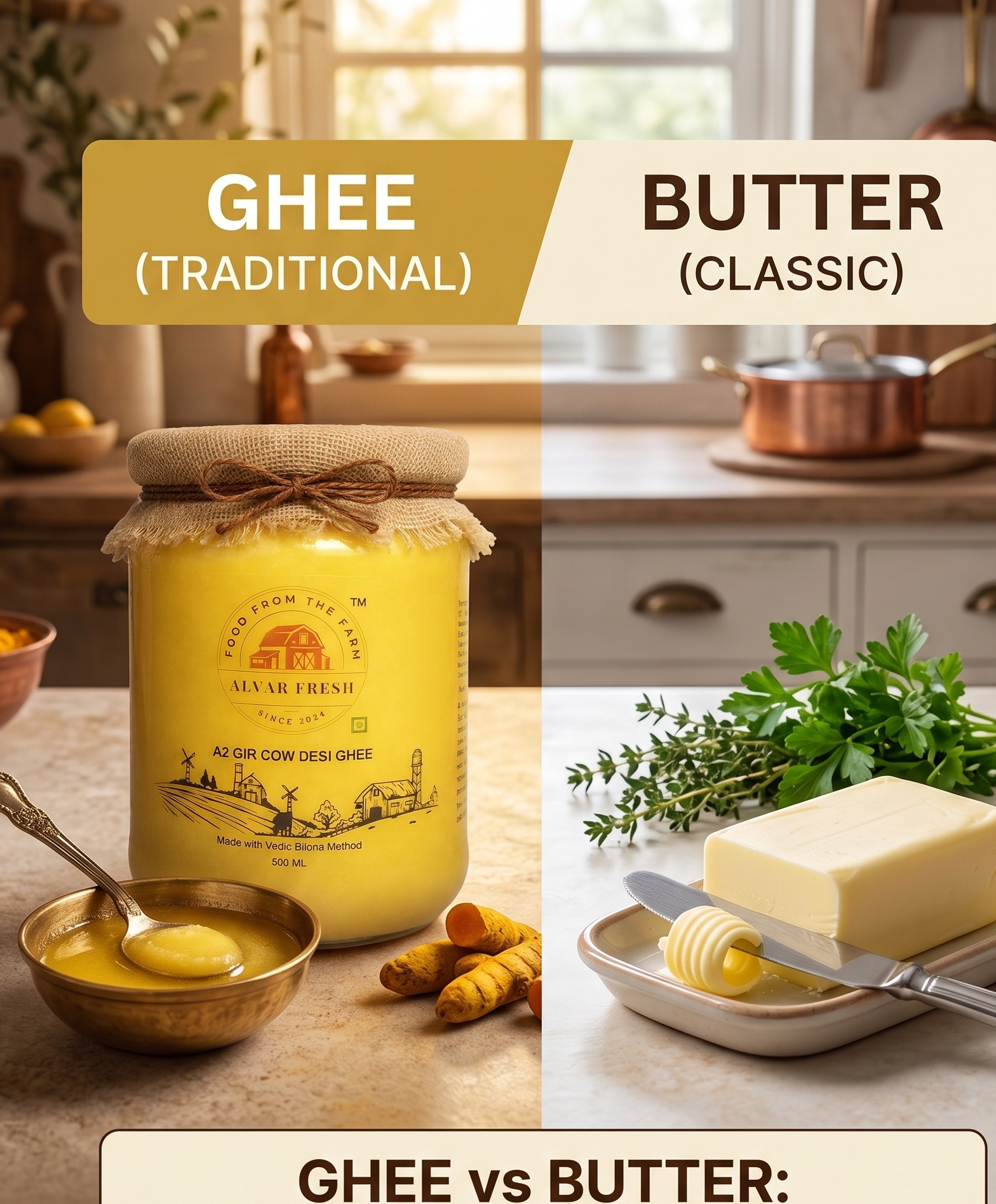
Before we get into which one wins, it helps to understand what makes them different at a fundamental level. Both ghee and butter come from the same starting point — cow’s milk fat. But what happens after that separates them completely.
Butter is made by churning cream until the fat separates. It contains roughly 80% fat, around 16-18% water, and the remainder is milk solids — including lactose and casein protein. That water content and those milk solids are what make butter behave the way it does in cooking — burning at relatively low temperatures and going rancid faster than ghee.
Ghee starts as butter, but then goes through a slow-cooking process where all the water is evaporated and the milk solids are removed. What remains is essentially pure clarified fat — no water, no lactose, no casein. This is the heart of the ghee vs butter difference: ghee is more concentrated, more stable, and dramatically easier on the digestive system for most people because the components that cause dairy sensitivity are completely absent.
The Smoke Point Difference Nobody Talks About Enough
This is one of the most practical aspects of the ghee vs butter comparison — and it is one that directly affects your health every time you cook. When a fat reaches its smoke point, it begins to break down and release harmful compounds called free radicals and aldehydes. Cooking repeatedly in oils or fats past their smoke point is genuinely not good for you.
Ghee has a smoke point of around 250°C. Butter burns at roughly 150°C. That 100-degree difference is enormous in real cooking terms. Indian cooking — with its high-heat tadkas, deep frying, and sautéing — demands a fat that can handle serious heat without breaking down. In the ghee vs butter comparison, ghee wins this round completely and without argument.
Lactose and Dairy Sensitivity — A Crucial Difference
If you or anyone in your family has ever felt bloated or uncomfortable after consuming dairy, the ghee vs butter question becomes even more important. Butter retains lactose and casein, which are the two components most commonly responsible for dairy intolerance symptoms. Ghee, because of the clarification process, contains essentially none of either.
This means people who genuinely cannot tolerate regular dairy can often consume ghee without any issues at all. It is one of the reasons Ayurveda classified ghee as a therapeutic food long before the concept of lactose intolerance had a name — the ancients simply observed that ghee sat well with people in a way that raw dairy often did not.
Is Butter Healthier Than Ghee? Let’s Look at the Numbers
Short answer: no. Longer answer: it depends on what you mean by healthy and what you are using it for — but in most comparisons, the ghee vs butter verdict leans consistently toward ghee.
Per tablespoon, ghee is slightly higher in calories and fat than butter — simply because it is more concentrated with no water diluting it. But calories alone do not determine how healthy a fat is. The quality of the fat, how it behaves during cooking, and how your body processes it matter far more than the raw calorie number.
Where Ghee Pulls Ahead Nutritionally
Good quality ghee — particularly ghee made from grass-fed desi cow milk using the traditional Bilona method — carries a genuinely richer nutritional profile than standard butter. It contains higher concentrations of fat-soluble vitamins A, D, E, and K2. It has more CLA, which research has linked to improved metabolism and reduced inflammation. It contains butyric acid, a short-chain fatty acid that feeds the cells lining your gut wall and plays a meaningful role in digestive health.
Butter has some of these too — but in lower amounts, and without the stability that comes from ghee’s clarification process. In the ghee vs butter nutritional comparison, ghee made from quality milk is simply the denser, more bioavailable option.
What About Saturated Fat?
Both ghee and butter are high in saturated fat — and this is where a lot of people get nervous. But the conversation around saturated fat has shifted significantly over the last decade. The blanket “saturated fat causes heart disease” narrative that dominated nutrition advice through the 80s and 90s has been substantially walked back by more recent research. The type of saturated fat, what it is consumed with, and the overall dietary pattern matter far more than the presence of saturated fat alone.
In the ghee vs butter context, neither is the villain it was made out to be — provided it is consumed in reasonable amounts as part of a balanced diet. The problem was never really ghee or butter. It was the ultra-processed foods and refined carbohydrates that surrounded them.
📖 Related read
Pure Desi Ghee: How to Identify, Choose & Never Get Fooled Again
To get the full nutritional advantage in the ghee vs butter comparison, you need genuine pure desi ghee — not a commercial imitation. Here is how to tell them apart.
Read the full guide →
What Do Cardiologists Say About Ghee?
This is the question that makes most people nervous — and understandably so. For decades, any fat that was high in saturated fat got lumped into the “bad for your heart” category. Ghee, being almost entirely fat, took a lot of that heat. But the cardiological conversation around ghee has evolved meaningfully in recent years — and it is more nuanced than either side of the ghee vs butter debate usually admits.
The Old Fear vs the New Understanding
The original concern was straightforward: saturated fat raises LDL cholesterol, high LDL causes heart disease, therefore saturated fat causes heart disease. Avoid ghee. Avoid butter. Use refined vegetable oil instead. This advice was given confidently for decades — and it turned out to be significantly more complicated than that.
More recent research has shown that LDL is not a single uniform entity. There are different particle sizes of LDL, and they behave differently in the body. Large, fluffy LDL particles — the kind that dietary saturated fat tends to raise — are not nearly as strongly associated with cardiovascular risk as small, dense LDL particles. Meanwhile, some of the refined vegetable oils that replaced ghee and butter in Indian cooking have their own problems — particularly when heated repeatedly to high temperatures, which is exactly how they tend to be used.
What Studies on Ghee and Heart Health Actually Show
Several Indian studies have looked at ghee consumption and cardiovascular markers specifically. The findings are not alarming — in fact, for people consuming ghee in traditional amounts as part of a balanced diet, the outcomes were largely neutral or mildly positive. Some cardiologists now openly acknowledge that moderate ghee consumption — particularly of good quality ghee like the kind that wins the ghee vs butter comparison — is not the heart risk it was once assumed to be.
The key phrase there is “moderate consumption.” Neither ghee nor butter in unlimited quantities is going to be good for anyone’s heart. But replacing refined oils and processed fats with moderate amounts of good quality ghee is a very different conversation — and increasingly, cardiologists are willing to have it.
The Butyric Acid Angle
One thing that rarely comes up in the mainstream ghee vs butter conversation but probably should: ghee is one of the richest dietary sources of butyric acid. Butyrate is a short-chain fatty acid that research has linked to reduced gut inflammation, improved intestinal barrier function, and even potential benefits for metabolic health. A healthy gut and a healthy heart are more connected than most people realize — and ghee’s butyrate content puts it in a genuinely interesting position nutritionally.
What this means practically
Ghee in moderate daily amounts is not the cardiac villain it was once painted as · Quality and quantity both matter · Replacing refined vegetable oils with ghee may actually be the smarter cardiovascular move · Always consult your own doctor for personalized advice
Should I Replace Butter With Ghee? Here Is My Honest Answer
Yes — for most people, in most cooking situations, replacing butter with ghee is a genuinely good decision. And the ghee vs butter comparison makes this case pretty clearly once you look at it practically rather than emotionally.
For high-heat Indian cooking — tadkas, stir-frying, sautéing onions, roasting vegetables — ghee is simply the better choice. It handles the heat without breaking down, it does not burn and turn bitter the way butter does, and it adds a depth of flavour that butter cannot replicate in the context of Indian food. This is not nostalgia talking. It is basic food science.
When Butter Still Makes Sense
I want to be fair here because this is genuinely a ghee vs butter comparison and not a ghee-always-wins essay. Butter has real advantages in certain contexts. For baking — cakes, cookies, pastries — butter’s water content and milk solids actually contribute to texture and structure in ways that ghee cannot fully replicate. For spreading cold on bread, butter’s softer texture at room temperature works better. For Western-style cooking at lower temperatures, butter’s flavour profile is sometimes exactly what a dish needs.
The ghee vs butter question is not really about eliminating one entirely. It is about knowing which one belongs in which situation — and understanding that for the majority of Indian cooking and daily consumption, ghee is the more sensible, more nutritious, and more culturally appropriate choice.
Making the Switch Practically
- Use ghee for all high-heat cooking — tadka, frying, roasting
- Add ghee to dal, rice, rotis and parathas instead of butter
- Use ghee as a finishing fat on vegetables and soups
- Keep butter for baking and cold spreading if needed
- Start with one teaspoon of ghee per meal and see how your body responds
- Choose Bilona A2 ghee for the fullest nutritional benefit
🔍 Go deeper
A2 Cow Ghee: What Nobody Actually Tells You Before You Buy
If you are making the switch from butter to ghee, make sure the ghee you pick is the real deal. This post explains what A2 means and why it matters for your daily cooking.
Read the full guide →
Is Ghee High in Cholesterol? Let’s Clear This Up
This is the question that stops a lot of people from making the switch in the ghee vs butter debate — and it is one that deserves a straight, honest answer rather than the usual hedging.
Yes, ghee contains dietary cholesterol — roughly 33mg per tablespoon, which is comparable to butter. But here is the thing most people do not know: dietary cholesterol has a far weaker effect on blood cholesterol levels than was once believed. For the majority of people, the liver regulates cholesterol production in response to dietary intake — meaning when you eat more, it produces less, and vice versa. The relationship is not as direct or as alarming as the old advice suggested.
The Ghee vs Butter Cholesterol Reality
In the ghee vs butter cholesterol comparison, the numbers are similar. Neither has a dramatically higher cholesterol content than the other. But ghee has one significant advantage: it contains no trans fats, provided it is made properly from pure dairy fat without any hydrogenated oil adulteration. Trans fats — found in many commercial butter substitutes and processed foods — are far more damaging to cholesterol profiles than either ghee or natural butter.
Ghee also contains CLA and butyric acid, both of which have been studied for their potential to support healthy lipid metabolism. So while ghee does contain dietary cholesterol, the full picture of how it interacts with your body is considerably more favorable than a single number suggests.
Who Should Be More Careful
People with existing cardiovascular conditions or familial hypercholesterolemia — a genetic condition that affects how the body handles cholesterol — should always consult their doctor before making significant dietary fat changes. For everyone else, consuming ghee in traditional Indian amounts as part of a balanced whole-food diet is not the cholesterol crisis it has sometimes been made out to be in the ghee vs butter conversation.
The practical cholesterol takeaway
Ghee and butter have similar dietary cholesterol · Dietary cholesterol affects blood cholesterol less than previously thought · Ghee contains no trans fats when made properly · CLA and butyric acid in ghee may support healthy lipid metabolism · Moderation and overall diet quality matter most
🏆 Also worth reading
The Best Ghee in India: What to Actually Look For Beyond the Label
Now that you know ghee wins the ghee vs butter comparison — make sure you are buying the right ghee. This guide tells you exactly what to look for.
Read the full guide →